Criminal Justicisation
The United Nations and other inter-governmental organisations (IGOs) sit above national systems of law and justice. They set up their own systems of accountability, often with Member States in a governing capacity.
By definition, international organisations exist across national systems, laws and governance customs. Laws in Colombia, Denmark, Algeria, Lesotho, Vietnam, Samoa or ‘even’ the P5[1] are not applicable at this supra-national level; organisation specific rules are required. This applies to disciplinary and justice systems including for the management and adjudication of alleged problematic, prohibited behaviour in the workplace.
Termed unsatisfactory conduct or misconduct, these behaviours range from misrepresentation, forgery and discrimination to breach of confidentiality as well as harassment (including sexual) and sexual exploitation.
Misconduct also applies to “Unlawful acts (e.g. theft, fraud, the possession or sale of illegal substances, smuggling)”. Sexual harassment and sexual exploitation are not listed as unlawful acts, though they may of course involve sexual violence.
These internal mechanisms are not criminal justice systems, they are internal administrative systems. If someone is found to have engaged in prohibited behaviour the sanctions they can face are varied and workplace based, from the recovery of funds to termination of employment. Nobody can be sent to jail, acquire a criminal record or lose their freedom of movement.
High standards are in place in criminal justice systems for allegations to be upheld; the consequences of such decisions can involve the removal of rights, and in some States, the death penalty. A high bar has to be reached for conviction when such severe consequences may follow: that bar is that an allegation be proven beyond a reasonable doubt. Other provisions exist to reduce[2] the likelihood of wrongful convictions too, such as the presumption of innocence.
Migration of these criminal justice norms into administrative procedures does not make sense. Discrepant sets of outcomes should not accompanied by processes which are conceptually framed in the same ways. Civil justice systems, again without the possibility of incarceration, work on the standard of a balance of probabilities, or preponderance of evidence, for an allegation to be upheld, ie that it is more likely that the allegation is true than it not be true.
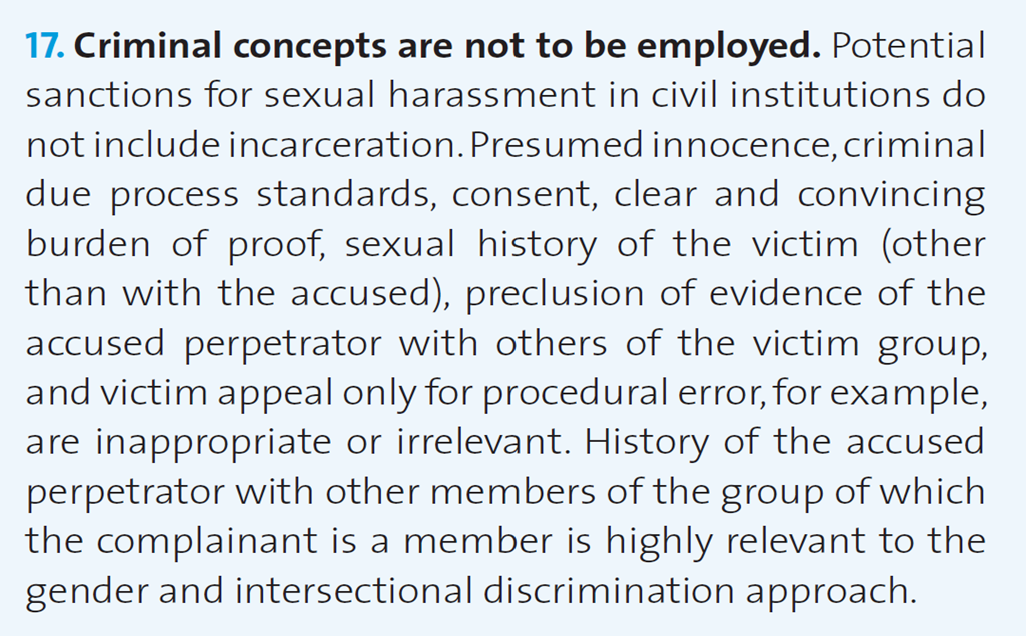
The internal administrative processes in IGOs are not criminal justice systems. Yet some employ criminal justice system principles, which can serve to benefit the person against whom an allegation is put. These include a presumption of innocence and that an allegation must be proved beyond a reasonable doubt (other criminal justice concepts are also employed – see below). Because the public has become accustomed to these ideas and they enter our instinctive thinking about justice, it can be difficult to dislodge them. Discussions about different systems and alternative ways of working have repeatedly to be advocated, including – unsurprisingly – in organisations where lawyers draw up rules and procedures and especially so where the organisation has a criminal justice mandate, such as the ICC.
In a publication I wrote for the UN in 2018 with Professor Catharine MacKinnon, she set out Core Elements of Effective Sexual Harassment Policy and Procedure. One such element addresses the issue of importation of criminal concepts:
The ongoing case against the ICC Prosecutor has had two signifiants arms of inquiry and interpretation: a year-long investigation by the UN’s Office of Investigation and Oversight Services (OIOS) and a review by a panel of three judges, tasked with giving a legal interpretation of the OIOS report. The OIOS is reported to have found that the Prosecutor’s conduct towards the woman who alleges sexual harassment “escalated over time, resulting in him engaging in nonconsensual sexual conduct with her”. The Panel, which unlike OIOS adopted the standard of proof of beyond a reasonable doubt, concluded that there was insufficient evidence to support a finding of misconduct.
To be clear: the OIOS concluded that the Prosecutor engaged in nonconsensual sex; the Panel said this is not misconduct. We must be cognisent of what message this sends to others who have been subjected to sexual harassment and suffered its consequences.
Administrative systems have inappropriately adopted criminal justice standards: this is a process of criminal justicisation. It ill-serves those harmed by sexual harassment and any organisations which seek to eliminate it.
My observations[3] here do not arise from the current ICC case; this has not prompted my position. I started making this case long before, as the UN publication linked and quoted above illustrates. But the ICC case exemplifies the muddle within the UN / associated IGOs in which sexual harassment case handling, and different standards in different parts of the system, leave those considering making a report in confusion as to procedures and their possible paths forward. It is fully understandable why a survivor of sexual harassment would choose not to make a report.
There needs to be a coherent approach, with concepts and standards that fit administrative, not criminal justice, proceedings. It remains to be concluded but I suspect that the ICC case will do little to encourage anyone in IGOs, including in the ICC, to report sexual harassment, making it even more likely that sexual harassers will feel confident of impunity for their actions.
Whatever happens now in the final stages of the ICC case, sufficient doubt has been raised with anyone genuinely seeking to end sexual harassment of whether these institutions have or can construct systems and cultures which are genuinely invested in that ambition.
[1] The permanent five States on the Security Council – UK, USA, Russia France and China. They were given their seats in 1945 and remain there today. Each of the P5 states has a veto and all have used it.
[2] Reduce, definitely not eliminate.
[3] Further and more legalistic discussion on standards has been offered elsewhere see eg Kaddoura
and Karnavas
Leave a Reply