Two things can be true
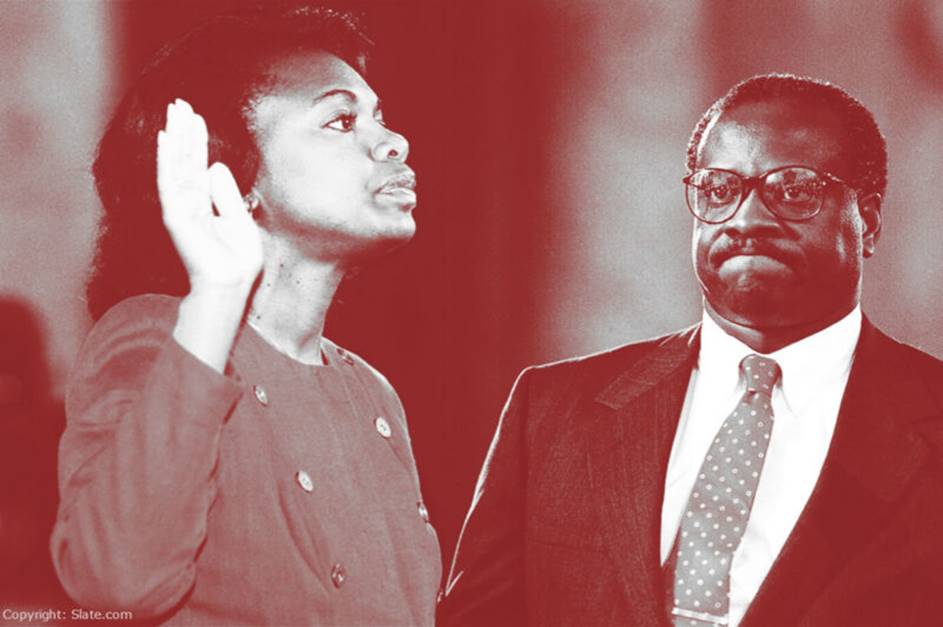
Anita Hill and Clarence Thomas, from https://www.aclu.org/news/womens-rights/how-clarence-thomas-confirmation-hearings-changed-how [1]
In 1991 when Clarence Thomas was nominated for the USA Supreme Court he faced accusations of sexual harassment from Anita Hill.
In his defence, Judge Thomas denounced what was happening as a ‘high-tech lynching’[2]. Thomas invoked the US history of racism, slavery, dehumanization and inequality through his declaration of a lynching. This term, this analysis, found purchase across the media and sympathetic reception among black men and women. Thomas’ use of deep and wide grievance about the USA’s history of racism worked at the very least to diffuse an open reception to Anita Hill’s experience. Collective anger and cross-generational injury mobilised sympathy across the country; black women and men rallied to his cause. If he were to be successful in seeking appointment to the Supreme Court it would illustrate that it was possible to write a different future for black Americans.
On the other hand, Anita Hill was vilified for turning against a black brother who had the chance at one of the highest positions in the land. This possibility was historic and magnificent and Hill was cast as the ‘uppity’ woman who stood in his way.
Kimberle Crenshaw, a leading legal scholar specializing in rights racism and law and who served in Anita Hill’s legal team, has noted that “[u[nderlying his comment was the idea that sexual harassment, like the feminism that pointed it out, was a white preoccupation incompatible with antiracism”
However, it is possible, indeed necessary, to hold to both at the same time[3]; two things can be true. It is possible to oppose, and be part of the struggle against, racism while also recognising that a black man can sexually harass.
The history of slavery and the civil rights struggle in the USA gave the Hill-Thomas case specific meaning. They do not map directly to the current ICC case involving its Prosecutor. But the two cases of alleged sexual harassment share a common device employed by many accused: the claiming of victimhood augmented by the invocation of a just cause which is somehow dependant on them. Anyone can claim victimhood (it is a noted pattern of behaviour amongst abusers) but the nature of its deployment by very powerful men (it is unusual for women to have comparable power) can distinguish from its use by others.
The elision of a political history of injustice with the personal plight of a very powerful man makes a potent mix. It can be wielded to corral support for the alleged abuser, who champions and represents a cause, as well as to obscure the accuser’s voice and legitimacy. It can mean there is limited, if any, willingness to hear what the accuser is saying.
Powerful men have networks which include other powerful men. The Epstein case has illustrated this to many who might previously have been unaware of how these networks support the men in them.
Wielding their positions of power and access to mass media enables men accused of abuse to air their efforts to link their personal challenges to bigger political agendas against injustice and violence. Doing so subordinates or sidesteps the need to look seriously at allegations through pivoting to ‘bigger’ agendas which rely on them for advancement, we are asked to infer.
Clarence Thomas pivoted to solidarity against a history of racism, a history which take a differfent shape should he, a black man, join the Supreme Court. The Prosecutor’s pivot is to solidarity against a history of discrimination and violence (too often lethal) against Palestine and its people, plus an ambition for international justice to hold to account those who are accused of genocide against them. The Prosecutor sought and obtained arrest warrants for parties to the confict between Israel and Gaza (widely seen as a genocide) with the International Court of Justice determining that there may indeed be a genocide ongoing against which protective measures are to be taken. It is evident that Israel has little if any regard for the Prosecutor and it has reportedly sought his removal. The cause of Palestinain rights and lives has found a champion in the ICC Prosecutor. Thus it is deemed that an anti-Palestine agenda infects the case against him.
These are the tensions which the two cases posit:
- Opposition to lynching/(lethal) racism means siding with Thomas
- Supporting the Palestinian cause means siding with the Prosecutor.
Any moves against the Prosecutor must, according to this logic, be in the service of the current Israeli government.
I have in another post said a little about how this narrative has landed on the victim-survivor but here I am interested in the deployment of a national/global justice project can be used to displace an openness (not even decision making) to the hearing from women making sexual harassment allegations. If allegations against the Prosecutor are associated with what is seen as unjust agendas, then his actions are less likely to be received as being substantively plausible. Not only does this leave his accuser invisible but also inaudible – she is lost and he is the saviour of a just cause.
And yet, it is in fact possible both to seek justice for Palestinians and to take seriously allegations of sexual abuse against the Prosecutor. And by taking these seriously I do not mean that one has immediately or unquestioningly to accept any word against him but to be open to the possibility that they might be true and that a less powerful woman may have something to which attention should be paid.
The massive discrepancy in power between the accuser and the accused in the ICC case, the voice of authority bestowed on the Prosecutor though his experience and position and his networks are cumulatively weighty. The power of his words and actions contrast starkly with her silence (required by her terms of employment) and negligible sympathetic hearing in much media coverage and are anathema to any notion of equal treatment.
The ICC Assembly of States Parties (which is the supreme governing body of the Court), and its Bureau, has had the task of managing, and soon will have to make final determinations, on this case. I don’t doubt that some ICC States will find the linkage of the Prosecutor’s defence to the defence of Palestine compelling. They may believe that only the current Prosecutor can progress this work; nobody else could take this forward. They may be persuaded that a man who has been able to have warrants issued must continue to lead this work. Or they may see that two things can be true.
Justice Thomas remains on the USA Supreme Court to this day.
[1] Image heads the article How the Clarence Thomas Confirmation Hearings Changed How America Talks About Sexual Harassment, 2016, by Gillian Thomas, Senior Counsel, ACLU Women’s Rights Project,on the ACLU website.
[2] Have we still not learned from Anita Hill? https://scholarship.law.columbia.edu/faculty_scholarship/2973/
[3] The need to do so and how that plays out is at the heart of Crenshaws work on intersectionality. See eg Mapping the Margins: Intersectionality, Identity Politics, and Violence against Women of Color.