Why (not) report?
Anyone who has looked into sexual harassment, supported a survivor or experienced it themselves is likely to know that surviving it can be a struggle in itself; reporting it is an additional world of uncertainty, lack of control and anxiety. It can be, and too often is, experienced as further abuse.
No matter if they claim to have zero tolerance or practice victim-centred work, official systems (especially criminal justice systems) have time and time again failed those who decide to report sexual abuse, including harassment. Women have been condemned for wearing the wrong clothes or being out at night or not fighting back sufficiently or continuing to work with her abuser after the abuse or continuing to correspond…the list goes on. Women who name their abuse are subjetcted to remarkable and crticial scrutiny.
More attention must go on understanding how and why men abuse (failure to face adverse consequences in justice and administrative systems is a significant factor), patterns of abuse, how an abuser has behaved with others before this attack and so on.
#MeToo has increased awareness of sexual harassment and of systemic failures around it. These include the failure to listen to survivors, to offer support, to prioritise (or even pay the slightest attention to) the well-being of those who report their experience and, crucially, to punish abusers.
Official reports of sexual harassment in workplaces tend to be made to internal systems.
These systems are often shepherded by Human Resources teams who know and expect to continue to work with both the reporter of abuse and the person accused of abusing, who is likely to be more senior both to the abused and often to the HR folk. It may be easier for some, and more personally profitable, to show deference to and to take care with a more senior colleague than a junior, an intern or a new staffer. This is especially so in an organisation, such as the UN, where rank is integral to almost everything, not least of all legitimacy, authority and credibility. Rank is not jettisoned in the handling of a report of sexual harassment, it remains relevant.
With good reasons, both to do with internal structures of power and broader social hierarchies, those who are abused have concerns about being heard with an open mind.
The principle of ‘innocent until proven guilty’.informs how colleagues in IGOs receive a sexual harassment report, whether formal or informal..Often unwittingly, through body language and tone of voice, but also through words and actions they convey to the reporter that they refuse to believe, because they start from the assumption of innocence, the corollary of which is that the reporter is lying. The people thus considering making a report or even having an informal chat with their manager are made fearful of their words falling on deaf ears and their harm remaining invisible.
The presumption of innocence is not appropriate in a workplace setting. It is appropriate in a court of law, where the possible adverse consequences of abuse can be much greater than in a workplace, as I have written in my post on criminal justicisation. The appropriate principle in a workplace setting is to assume nothing, to be open to the possibility that the abuse may have happened or it may not.
Staff need to cognisant of the huge step that is reporting, the risks involved and the potential consequent harms. The likelihood of just outcomes and the making of reports is very much shaped by the actions of those who first receive them, even in informal conversations.
The failure to be able to listen without prejudice to reports of sexual harassment has been a recurring theme of the global discussion on sexual harassment. Organisational engagements with those who report can be supportive as well as non-conclusive about the actuality of events or behaviours.
There are many reasons not to report that are well recognised by anyone considering making a report. Here are some that I listed in a 2019 publication for the UN:
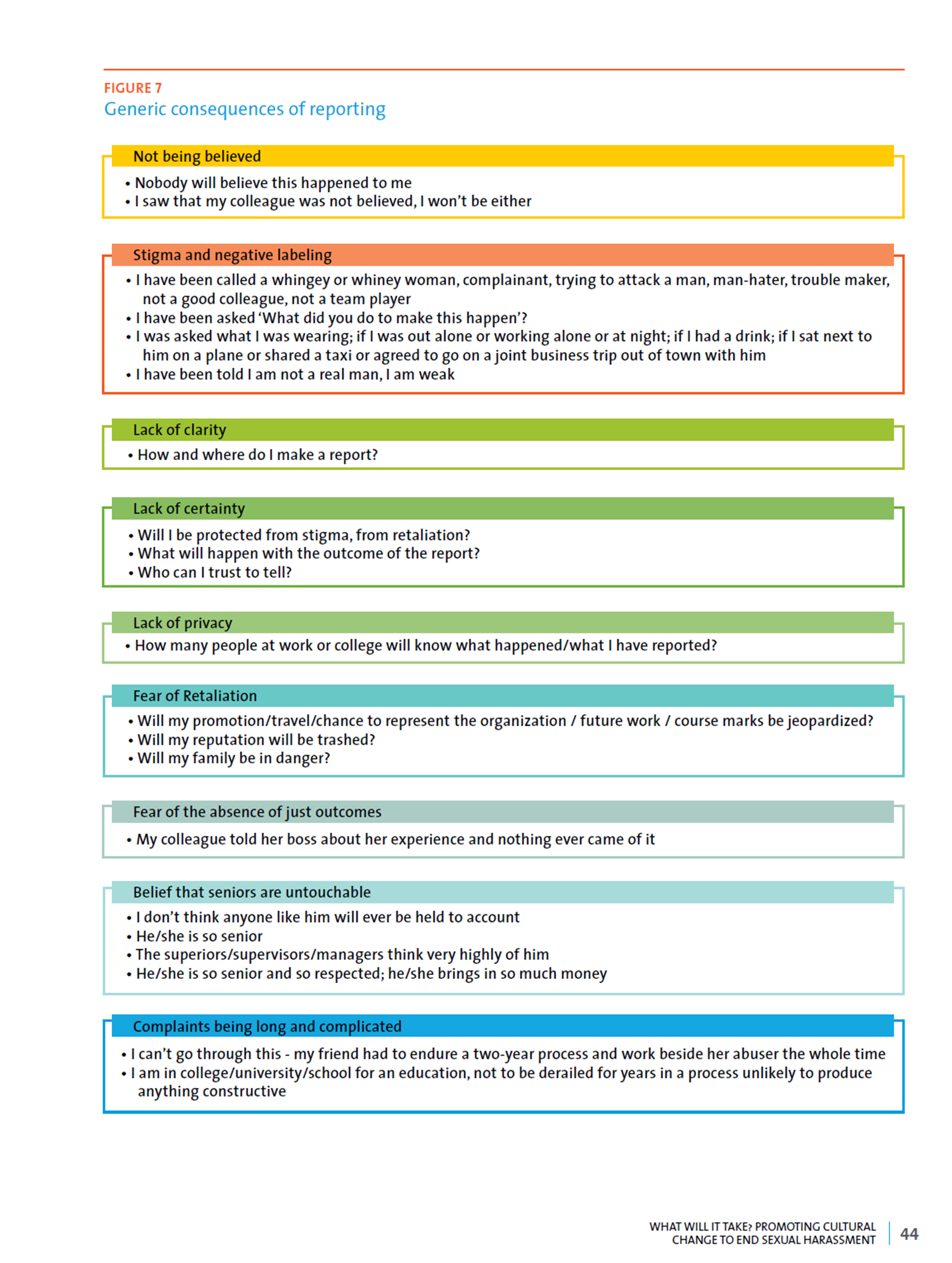
One could argue that against this panoply of conerns, and others, reporting is irrational. Changes to systems to address their shortcomings, to remove what inhibits reporting, are slow and yet survivors are expected to use and believe in them. This doesn’t work – except for employers to claim that there is nothing for them to do as there are no reports or to claim that there is no issue in their workplace.
Sexual harassment is a human rights violation, primarily of gender inequality, interlaced with other discriminations. The majority experience of harassment is by men, usually with a discrepancy in rank (senior man, junior woman or man), with sexual orientation, disability, race, immigration and other patterns of inequality implicit in these dynamics. These inequalities undoubtedly shape how a survivor is heard and seen, what credibility she is given and how she is perceived more broadly, eg uppity, stroppy, a nuisance. Men can be subject to judgements of inadequate manhood if they report.
People with disabilities are simply not given the credibility of others, even though that too is often limited, in their reports of sexual violence. Intolerable views of their perceived unattractiveness or asexuality underlie refusal to hear or believe them. Those who are dependent on their employer for, eg, a visa, health coverage, schooling for their children risk giving up so very much by reporting, risking retaliation or job loss should their case not be upheld. The latter situation is known across IGOs. Racial difference also play into preconceptions of worth and credibility – we will not progress far if we ignore that a black woman making accusations against a white man will likely find both racial and gender prejudices and stereotypes in play. Serious work to support reporting must address these complexities.
Women are also accused of failing to understand that ‘boys will be boys’ or of having no sense of humour. Though disappointing or even gut-wrenching, such responses are not a surprise, for the rampant and untamable nature of male sexuality is a message conveyed through culture across many contexts. It is women’s responsibility, we are told, to anticipate, manage and co-exist with this purported fact of life.
Reporting is thus is in its essence transgressive and opens anyone who rejects sexual abuse to scrutiny and judgement, even if their employment performance is stellar.
These are norms with which we live and which invade our workplaces UNLESS specific actions are taken to disrupt them. Therein lies the work of culture change and prevention.
Survivors will also consider what has happened with those who have previously made reports, if any. There will be talk of how long it can take for a case to conclude, of negative outcomes, of having to continue to work with/alongside the alleged harasser. They will be told about reports that were not upheld; in the absence of other known outcomes or if upheld reports are few, these accounts can discourage reporting. When people enquire, they will hear of survivors who have left their jobs rather than work with their harasser or make a report.
Many men and women who do report abuse are concerned not only for themselves but for others in their workplace. They don’t want others to experience the sexual harassment that has come their way. This objective should be that of the employer too, for allowing a harasser to remain in place unchecked risks not only similar or worse for others but will damage their reputation too; the latter regrettably being more important to some employers.
We don’t know how many potentially illustrious careers have been destroyed. We simply don’t know how much talent, creativity and contribution has been foregone or the breadth of employers and industries that have lost good staff to poor handling, and limited efforts at prevention, of sexual harassment. What an absolute waste.
Should someone experience sexual harassment from a senior, powerful boss and have the temerity to make a report, the current ICC case is salutary.
They will no doubt observe and take note as a powerful man voluntarily goes on leave, presumably on full pay, gives a long interview to a journalist who has a huge audience, and have his case put in mass media outlets by his lawyers and sympathisers. He can afford to engage a number of lawyers, he can claim victimhood, put his case and declare that he has been cleared, even before the case is concluded.
No conclusion on whether or not the report is upheld or assessment of whether or not the allegations have a factual basis, are needed for the observations made here. I note that the dynamics, behaviours and power imbalance in the ICC case will demand the attention of anyone who experiences sexual harassment and considers reporting.
The woman concerned has observed the requirement on her to uphold confidentiality, her account has not been aired in the media by her or her circle and I worry, as do others, about what lies ahead for her as this case comes to an end. If insinuations stick that she is somehow caught up in Israeli actions against the Prosecutor, her prospects will be severely damaged. If he returns to work what will she do?
I also fear for the Office of the Prosecutor about the damage of this case to its work. Careful, thoughtful, knowledgable and supportive efforts are crucial in an environment that is divided and already subject to considerable external pressures. It will be a fragile working environment for some time yet.
I have no doubt that this case, even before its conclusion, will reverberate across IGOs to discourage others from making reports of sexual harassment.
Many people are invested in work towards equality in the workplace and the elimination of sexual harassment. The ICC case is one we will talk about and learn from for a very long time. In ‘we’ I include not only policy makers, advisors and lawyers (survivors included amongst these groups) but also anyone considering making a report.
Leave a Reply